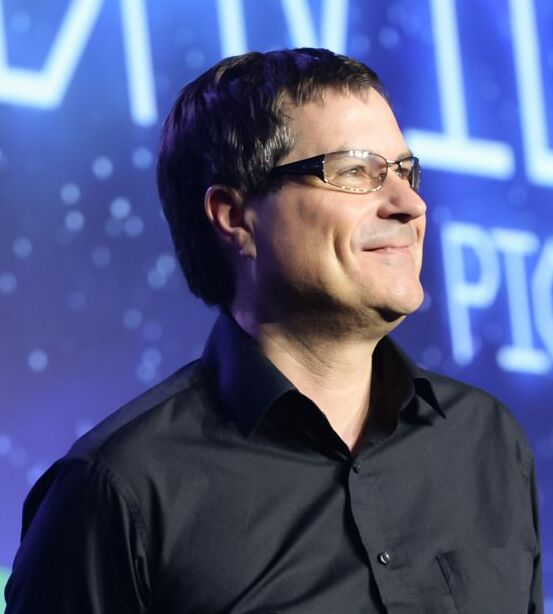
Congratulations to David Braben (BHCHS 1975-82) who has been selected for membership of a rather exclusive club for geniuses. Click HERE to read more about David and his credentials for joining this group.
Our new site for OB News has now been running for two months and thanks for the feedback so far.
I was half expecting someone to ask me if they can post comments on here. I haven’t yet discovered how to achieve this but I am not yet convinced it is a good idea to nudge the site towards the Facebook model. You are very welcome to make comments on anything you see here, and send them to me in a message. I can then make an editorial decision about whether, and how to publish these comments.
A reminder that our original website (www.bhchs.co.uk) will continue to be used for archiving, and to hold the database which has details of when you were at BHCHS and other details. We’d love to keep in contact with all former pupils so if you think I may not have your current email address please contact me. Also, if you know of others who may not be in our network please direct them here.
Graham Frankel
Congratulations to David Braben (BHCHS 1975-82) who has been selected for membership of a rather exclusive club for geniuses. Click HERE to read more about David and his credentials for joining this group.
Early reports from the Annual Dinner last night indicate it was a great evening at the Theydon Bois Golf Club, with very positive comments about the excellent food. It is inevitable that numbers are on the decline. A notable absentee, almost unheard of in the history of the OBA, was our president Trevor Lebentz who was detained by a necessary hospital procedure. We are delighted to report that this went well, and we can expect Trevor to come bouncing back next year.
Another absentee was the OBA Editor. I was in an important rehearsal for a concert next week, and very sorry to have missed the Dinner. I raised a glass to you in my absence but it was Philip Glass, whose three songs for a capella choir is on our concert programme.
Crispin has kindly allowed us to share with everyone his excellent speech. You can read or download it HERE.
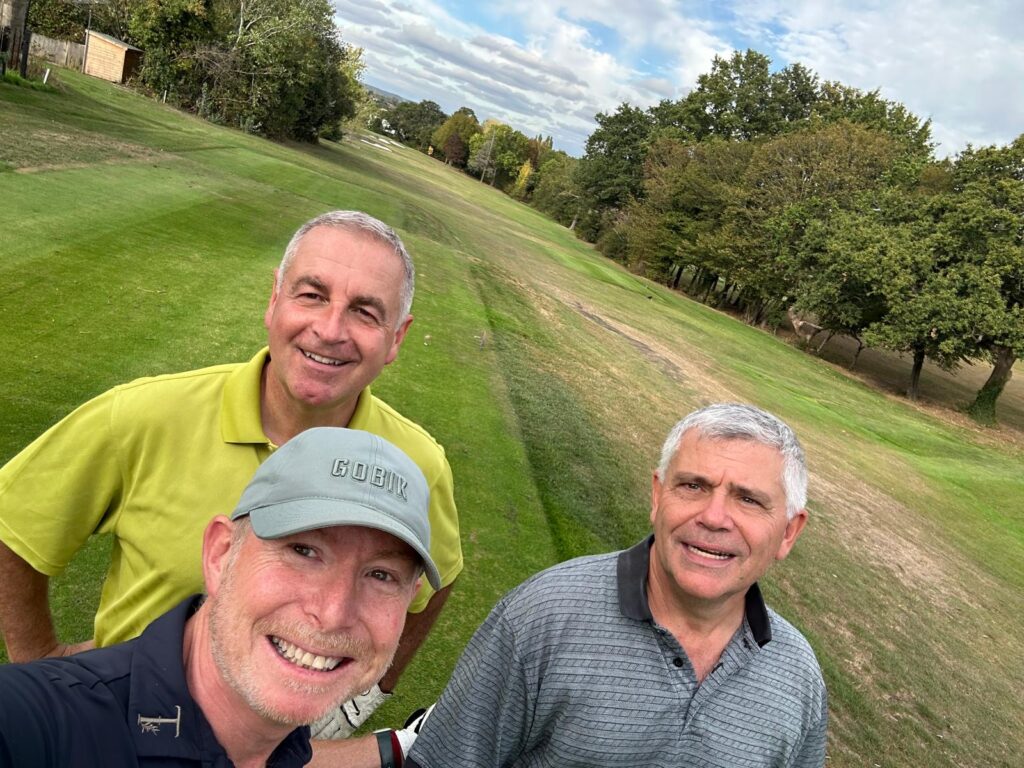
We don’t yet have any photos from the Dinner, but earlier in the day Crispin was playing a round of golf with Simon Allan (73) and Greg Southwell (74) who were both there in the evening.
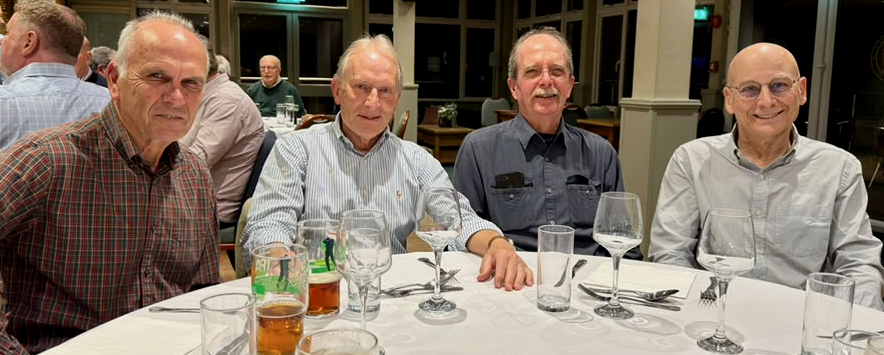
Thanks to Chris Kay (62) for this photo of him and his mates at the Dinner….
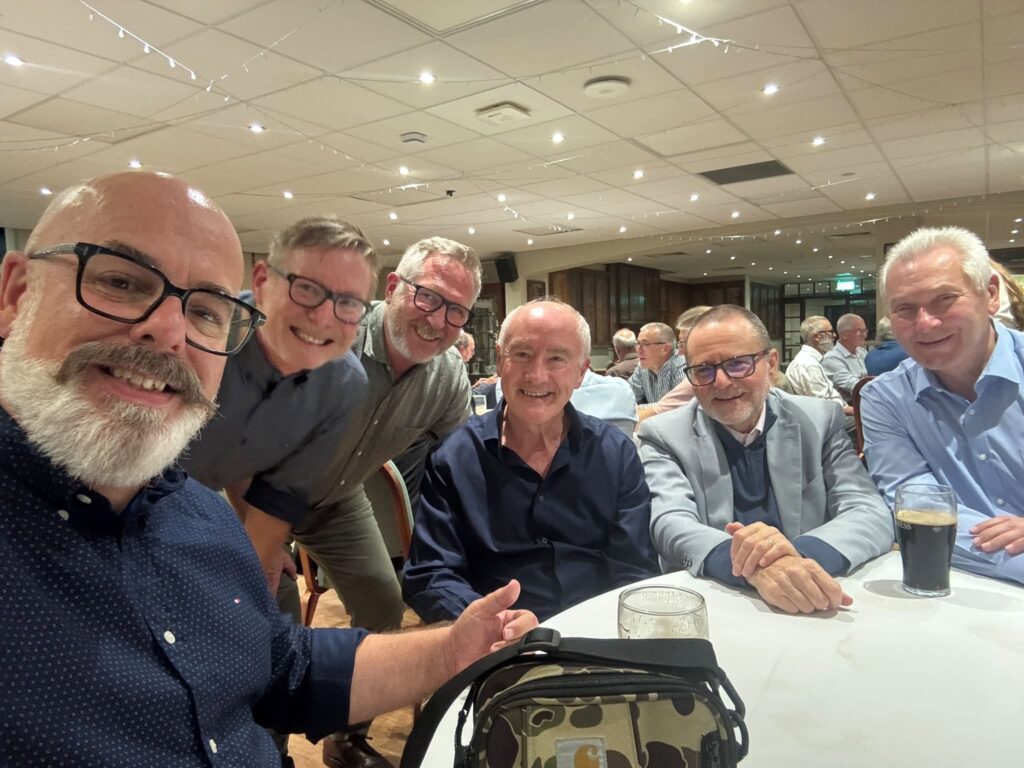
And here is the happy group from YOS 74…..
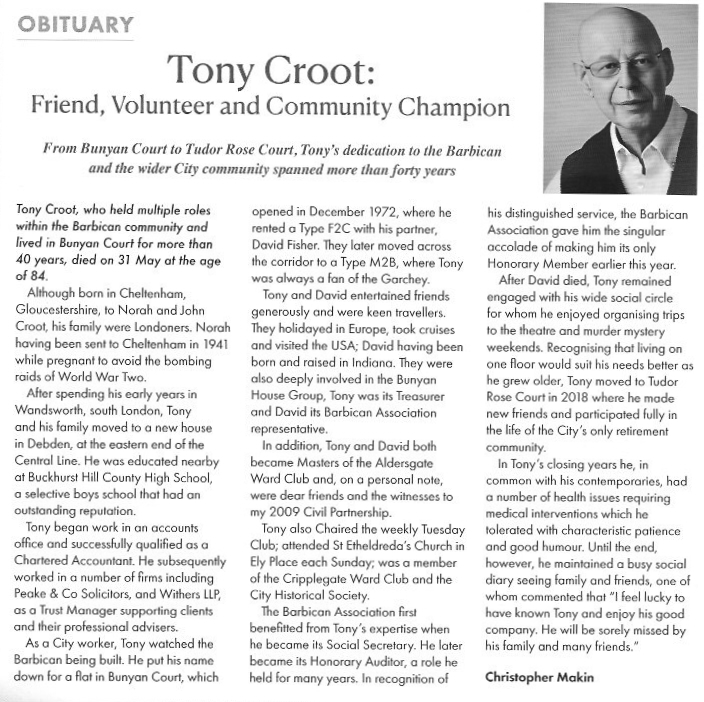
We have heard that Tony Croot (BHCHS 1952-59) died on 31st May 2026. This was reported by Martin Gorham (1958) and we are grateful to Martin for sending an obituary from Barbican Life, published by the Barbican Association.
The following deaths have been reported since July 2026. A reminder that the year shown in brackets is normally the year in which they started at BHCHS. But if they joined BHCHS later the year shown will be when they would have started if they had joined in the first year.
Roy Cuthbert (1942) died on 27th February 2022. He lived in Ferndown, Dorset. Information from his wife.
Doug Parrott (1943) died on 2nd November 2025. He lived in Newport, Gwent. Information from his son.
John Drake (1949) died in June 2026. He lived in Felixstowe. Information from Graeme Mason.
Barry Faulkner (1954) died on 9th July 2026. He had been suffering from cancer for several years. He lived in Cyprus. Information from his wife.
Rev Martin Seabrook (1954) died on 27th March 2026. He lived in Bromyard, Herefordshire. Reported by Rev Martin Turner (1959).
Duncan Jackson (1956) died in October 2018. He lived in Nailsea, Bristol.
John Hart (1958) died on 24th June 2024. He lived in Chigwell. Reported by his cousin Roy Hart (1938).
Breaking News
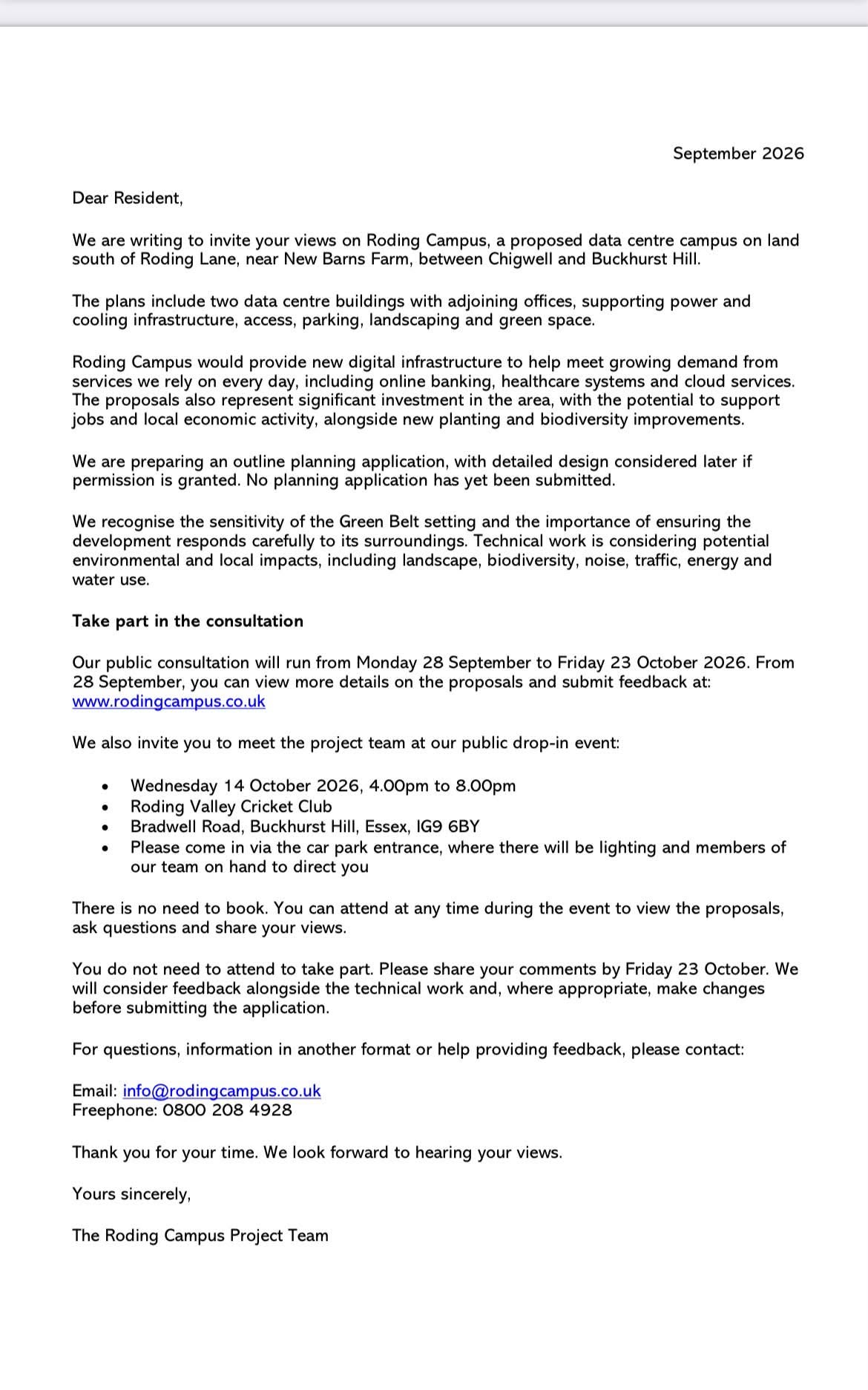
You may have read that the original plan to redevelop our school site has now been overtaken by a far more extensive proposal to build a huge data centre in the area.
A letter announcing initial public consultation on this plan how now been posted to local residents and a copy appeared on the Buckhurst Hill Life Facebook group.
Click HERE to view the letter.
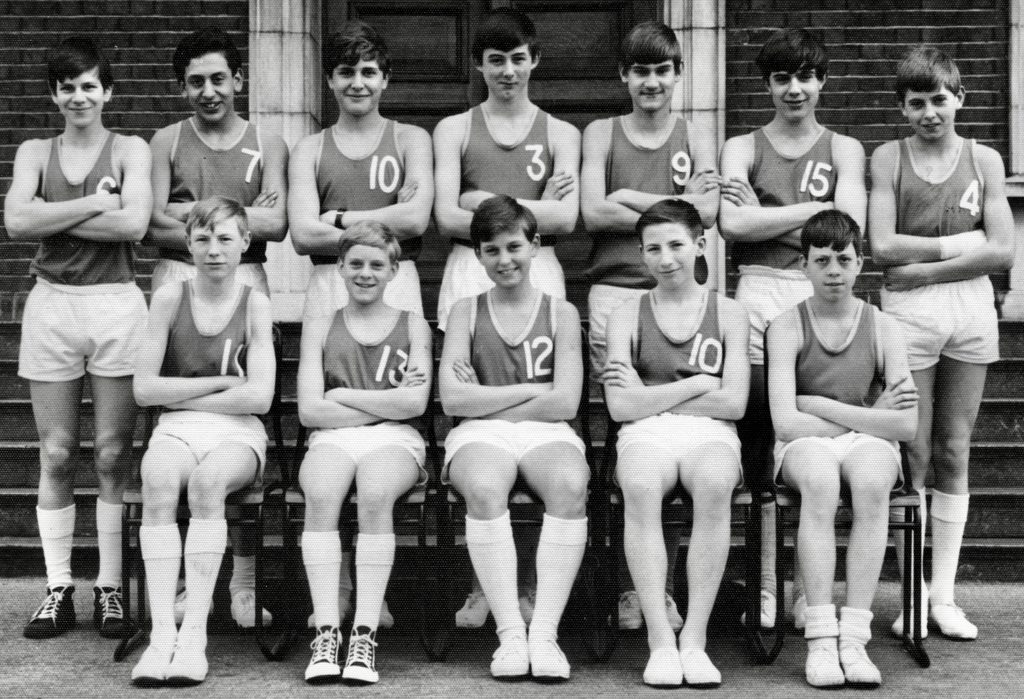
Although I don’t spend time these days hunting for the few untraced pupils, it is brilliant when someone turns up unexpectedly. We found William Watson (BHCHS 1964-70) as a result of an amazing coincidence. Fortunately for us, John Rippin (Music 1961-78) remains committed to our cause. William’s sister spoke to John who was making an occasional appearance at her church in Chingford. When she mentioned that her brother had lived in Canada for many years, it alerted John to the possibility that he was someone we’d failed to find.
In a matter of days I’d been able to explore William’s website and I strongly recommend a visit, even if you were not a member of his year group. It is a fascinating life story and he is one of so many (including me) who were inspired by John to develop a lifetime interest in music.
William has now been reconnected with his peers from BHCHS, including some of the members of the Under 13 basketball team (where William is shown above wearing the number 13 shirt).
Click HERE to visit his website.
For anyone interested in Old Buck stats, we now just have one from YOS 64 still untraced. The elusive person is Nigel Kent. And we still have some work to do with the nine Watsons among our pupils: only six traced so far. This may need a new Sherlock…
Challenge me if you can dispute this statement, but in the history of BHCHS I don’t think we came anywhere near producing an international cricketer. Vince Mulholland (BHCHS 1977-83) has now achieved that distinction. But he has gone even further. Representing England in the Over 60s World Cup held in Canada last month, his heroic efforts secured victory in a crucial semi-final match against Australia when he took the wicket of the Aussie’s leading batter, Peter Solway, just when the Australian looked set to pile up a big score. Vince is an all-rounder, but it was his fiendishly accurate medium pace bowling that helped England to victory during the early rounds. It was this pinpoint precision that trapped Solway lbw giving the England side a much-needed wicket maiden.
This set up what should have been a thrilling final against New Zealand. But the Canadian weather had other ideas. While Europe was melting in the seemingly endless heatwave, over in Southern Ontario they had several rain affected matches. Sadly, the final was a complete washout. Not even Messrs Duckworth and Lewis could help. But at least it meant England shared the title. I was delighted that Vince agreed to an exclusive interview with Old Bucks News soon after his return home to Loughton.
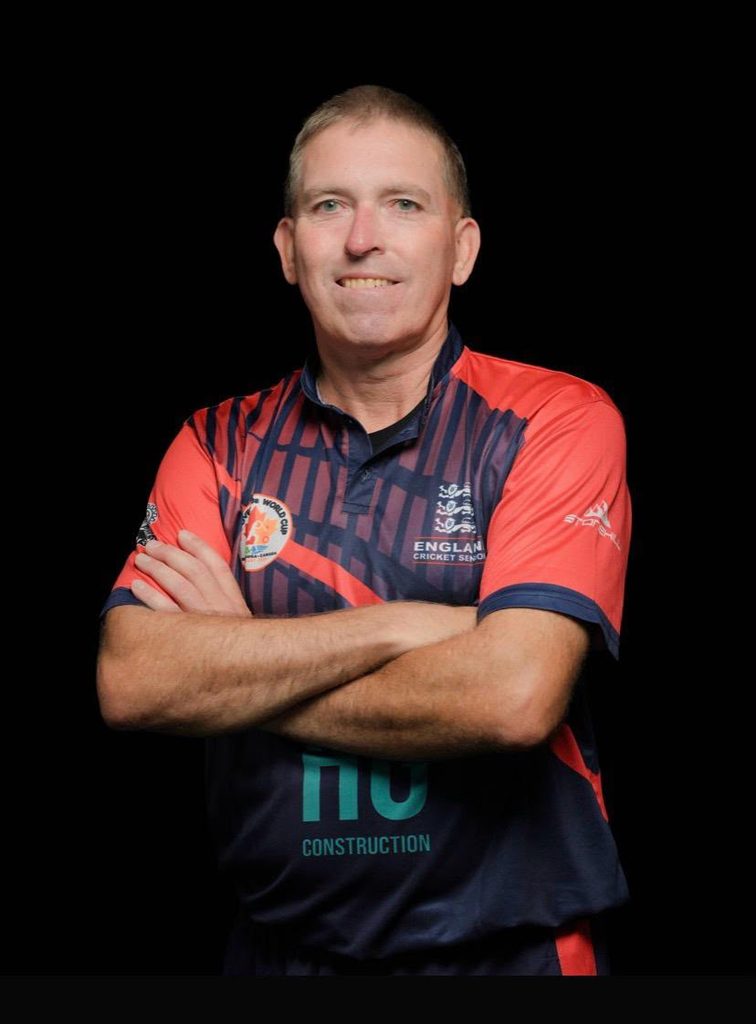
GF: How and when did you first become interested in cricket?
VH: I was the youngest of six children, and my earliest memories are playing in the back garden with one of my older brothers. Because he was bigger and stronger, he would beat me at every sport we played but it gave me a taste for competition.
GF: Were you encouraged to play cricket at BHCHS?
VH: Yes, Lionel Marsh was very keen on cricket. We played some school matches, and he also supported us by organising net practices. I vividly remember one occasion. It was my turn to bowl at him, and someone pointed out that he wasn’t wearing pads. He made some kind of dismissive comment that he was only playing against youngsters. I hit him on the leg, and he wasn’t happy. It was a moment for me, surprising him with my bowling and making me feel that I wasn’t too bad at this game.
GF: How did you then progress from school cricket?
VM: My walk home from school along Roding Lane took me past Buckhurst Hill Cricket Club, so I started there while still in the first year at school.
GF: Apart from getting your start in cricket, how did you feel about the rest of your time at BHCHS.
VM: To be honest, I didn’t enjoy it that much. I found it quite a tough environment it must have done me well as my exam results were not too bad. But the sports events and especially cricket was definitely a highlight.
GF: Did you play other sports there?
VM: I played for the school at football but having to wear glasses from age 13 meant that football was a problem, but I still played! I also was pretty good at badminton competing in the West Essex games, and athletics. I also remember playing quite well at chess, a highlight with that was a match against Chigwell school where I won my individual game.
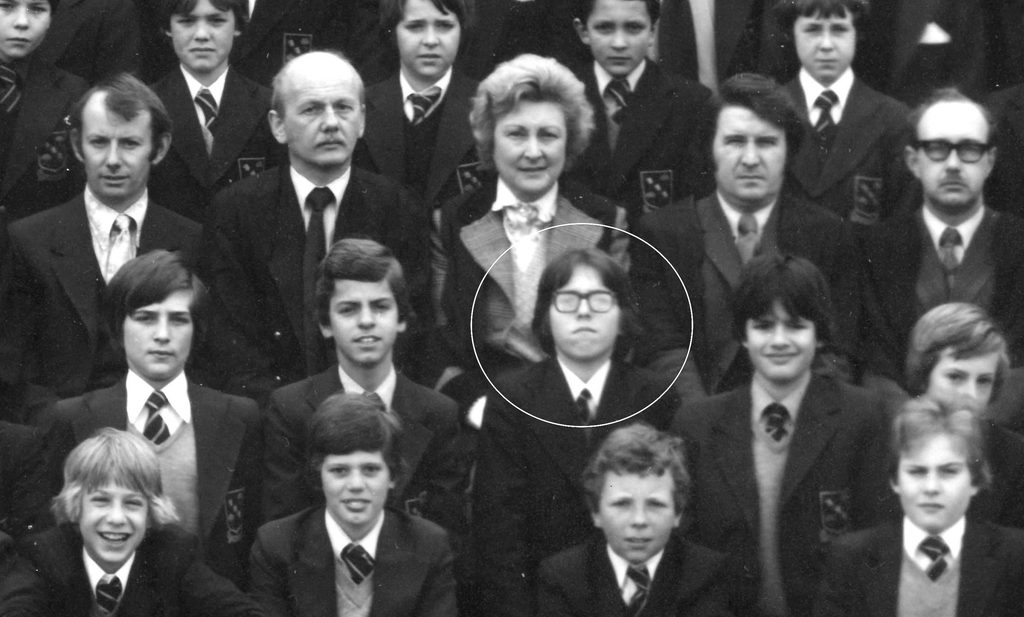
GF: Did you ever consider playing cricket professionally?
VM: Some of the Essex professional players, including Ray East used to come to Buckhurst Hill CC to coach and they kept an eye on my progress although there was no formal junior academy back then as there is now. At this point it was just a sport I really enjoyed and never thought of it as a possible career. Being the youngest of six in a family that was not particularly affluent, a big drive for me was to earn money. I had a paper round by the time I was 13 and I wanted to get a steady job as soon as I left school to help my family.
GF: Did you carry on playing cricket at club level?
VM: I had a few years out from playing during my late teens but then started back again in my early 20s playing for the Leyton Orient Supporters CC in some friendly games. I then joined Ilford Catholic CC playing League cricket. I have played first team cricket ever since, also becoming an active member of committee’s including the League Committee.
GF: Were your parents supportive of you playing cricket?
VM: My dad was from Ireland (he was garrisoned in Loughton in WWII where he met my mum). Being Irish, cricket was not really played there then and so he didn’t understand the game that much, but both parents were very supportive. My dad sadly passed away in my 20’s but my mum became really interested in cricket and always followed my progress, organising the teas for around 20 years when I was playing league matches.
GF: Were you inspired by any of the top cricketers in those early years?
VM: I admired many of the leading Essex players, especially Graham Gooch and John Lever, and I would often go and support them at Valentine’s Park when they were there. But if I had to pick one player who particularly inspired me it would be Ian Botham.
GF: What I noticed particularly about your bowling in the recent World Cup matches was your ability to hit a perfect length with almost every ball. Is that something you have always been able to do?
VM: I’ve always been pretty accurate, and I used to be quicker, being able to swing the ball in the air a lot more. Quite often my team mates call me “the metronome”.
GF: Although it was your bowling that was successful in Canada, I know you are listed as an all-rounder. Has that always been the case?
VM: Actually, I used to be more of a batsman. I opened the batting for my club for many years and was often top scorer in the club. But early on in my time at the club, when we were struggling in a match, I offered to bowl and picked up four wickets. The captain said, “Oh, we didn’t know you bowled.” So, from that point on I started bowling in every game and soon became the top wicket taker. Now, as far as Essex and England are concerned, I am a bowler who can bat.
GF: What did you do in your working life?
VM: As I mentioned, I was determined to get into work as soon as possible, and although I started in the 6th form, I got a job opportunity working in a local sub-post office at Woodford Green, so I left school at took the job. My manager there became a great friend. She quite soon told me that I was way too good to stay in that small sub-office and that I should get a job at The Post Office where they would, in her words, “pay me proper money”. I did just that. Within a year I was working in central London and rapidly got promoted. While working in the property section, the business sponsored me to become a qualified commercial accountant. This gave me further great job opportunities, a highlight being part of the joint venture team between the Post Office and Bank of Ireland that set up the Financial Services business. I left the Post Office with 30 years’ service and worked freelance for a few years, and then with KPMG in mergers and acquisitions. But when my mother got quite ill, I had to work less so I could care for her. After she passed away, I decided to spend more time on cricket before I formally retired in March this year.
GF: When did you first think that you might become an international cricketer?
VM: I’ve always played club cricket to a decent standard, and always competed in the top divisions whichever League I played in. When I got to the prime age of 50, I contacted the Essex manager to ask if there was a chance of playing for the Essex Over 50s. I quickly got a game and a year later was made captain of the 2nd team. Within a year, we’d won two titles, and realised that I was playing a good standard when compared to my age group. This inspired me to keep myself as fit as possible. I went on to win 6 finals as Essex Captain, playing in the 50’s side until last year. In a conversation with someone who knew an England player after a national cup semi-final last August, I was asked my age which was then 59. He said they were always looking for new blood in the England over 60s side. Just two weeks later I had a call to go to the Midlands for a Tri-Nations tournament. I did pretty well and soon afterwards I got a call asking me if I’d like to tour India in January with the England Lions. That tour also went well, and soon after I got the call to play in the England 1st team, as I turned 60 in March this year.
GF: What ambitions do you have now?
VM: Playing for England is the pinnacle for any cricketer, and I never expected to wear an England kit, nor to be so successful in the World Cup. It is a privilege an honour to represent the country and I will continue to do all I can to be part of the squad. But as you can imagine there are always more players coming up and reaching 60 so you have to do something quite exceptional to hold a place in the team. But I still love playing, love the team aspect of the game and I am always competitive. So, I will carry on pushing the barriers as best I can. Early next year, there is a tour to India and in the autumn, England will be visiting Australia for an ‘ashes’ tour. Of course, I would be delighted to be selected for these tours.
GF: It’s been great talking with you Vince, and congratulations again on your superb performance at the World Cup.
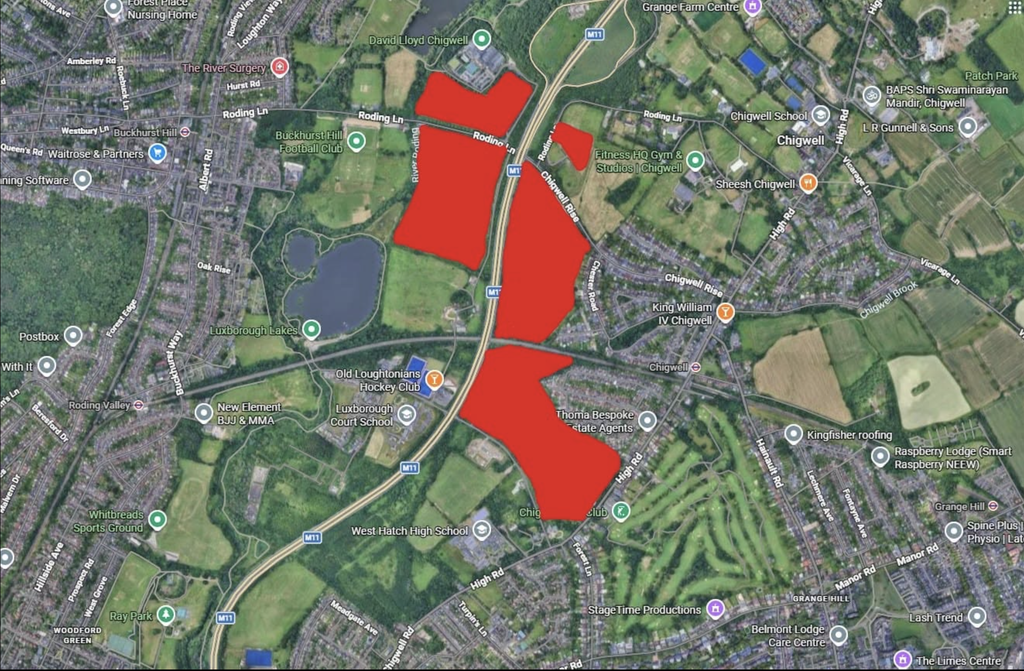
Thanks to Michael Turner (BHCHS 1981-86)for alerting us to a potential new development in Roding Lane. Based on this map, it appears to be around 6 times the size of the original proposal that made no progress after two years of consultation.
Michael found this on the public Facebook group Buckhurst Hill Life and so far there is no other information about the development, or even who is responsible for it. So until more information emerges we should not assume that it is even genuine.
Update 28/9: additional information posted on the Buckhurst Hill Life Facebook group states that the proposed new development is a data centre, 25 metres high and covering 24,000 square metres.
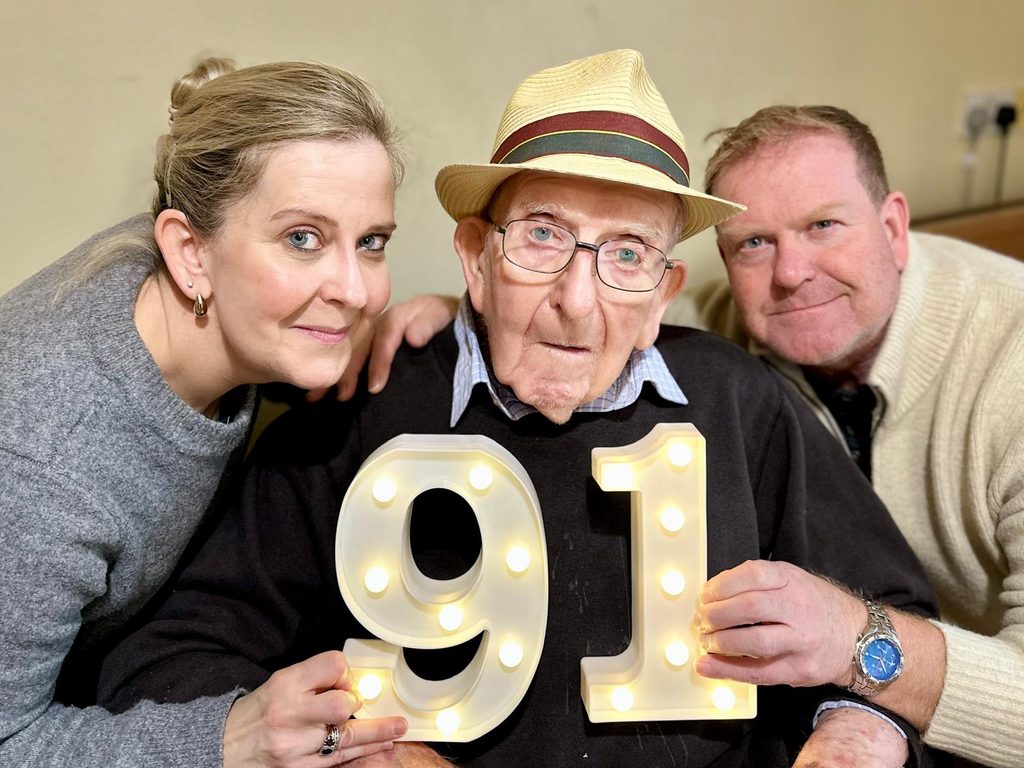
I have just heard that Ted Moran (BHCHS 1946-51) died on 5th September at the age of 91. The sad news was given to me by his daughter Liz Webber who has kindly kept Ted in contact with us through the last few years, and it reminded me that there are so many relatives who have help us in this way. They are among the unsung heroes of the Old Buck network.
Ted had a remarkably varied and busy career as a teacher, spending a large chunk of his adult life teaching in various countries in Africa. He gave us a comprehensive summary in our November 2003 edition, soon after we’d traced him via Friends Reunited. See page 18 for Ted’s contribution.
More recently, and thanks to Liz, we had managed to re-connected with Ted again after he had returned from South Africa. We reported this in January 2023…..
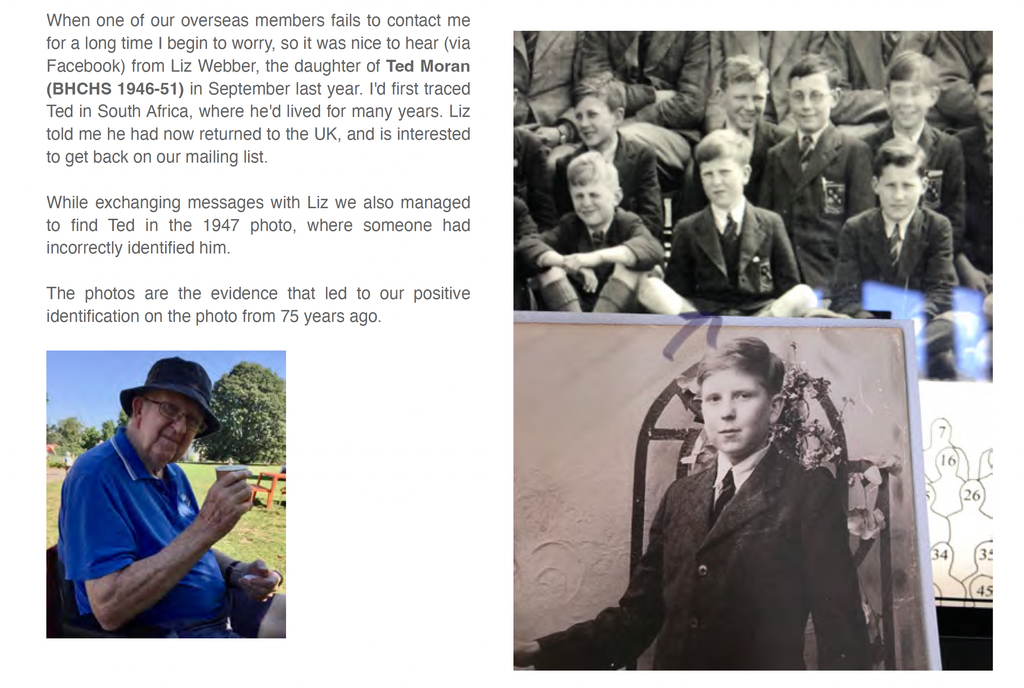
Here is an even more recent photo of Ted, celebrating his 91st birthday. Again, thanks to Liz for sending this.
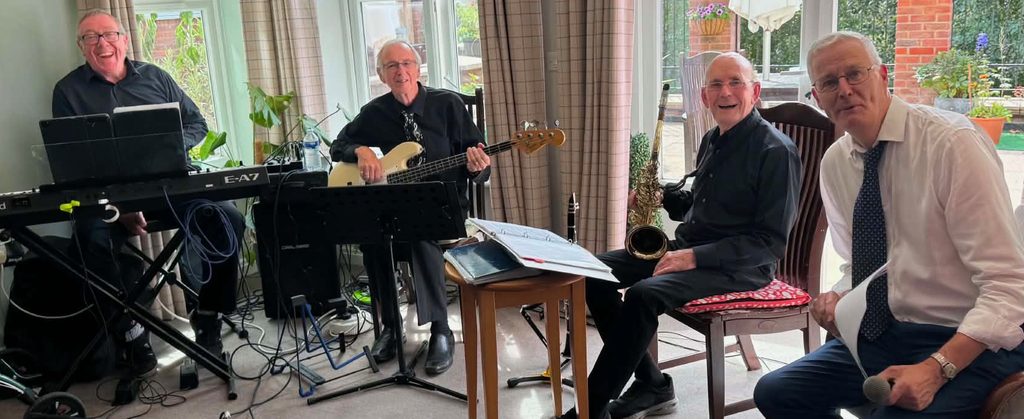
John Glasscock (BHCHS 1967-74) is keeping busy bringing music to appreciative audiences and helping worthwhile charities at the same time. Seen here with some of his band, John is on the left.
John writes……
I have been running a jazz band since 2003 when a group of us who attended an evening class, ‘Play Jazz’, at a local college formed a band and played at the open day of a local children’s hospice. Since then we have played at local venues in and around Basingstoke including village fetes, birthday parties, weddings, and jazz themed lunches.
I am a member of the Basingstoke Bridge Club and one of the members suggested that we should have a bridge club jazz band to play at the club Christmas party. That was in autumn 2023. Since then we have played regularly for community groups – including care homes, events supporting charities or mental health groups. We use these events to promote the bridge club and the benefits that playing bridge offers for mental health and social well being. We don’t charge for performing but we suggest a small donation for a charity which each of the band members nominates. We have 7 members of the band with a wide variety of experience. However, we all get great pleasure from sharing our enjoyment of playing together.
For me, the most memorable moment was when we played for a group of people who suffered with mental health issues. At the end, one of the carers approached me to thank the band and said that she had been looking after a lady for over 2 years, during which time she hadn’t spoken a single word. But through our performance, she sang along to a number of the tunes that we played (well known jazz standards) which brought a tear to her eye.
So as well as sharing the joy of making music together we all get immense satisfaction from hearing the positive feedback that we receive from each of the groups for whom we play.
 Users Today : 12
 Users Last 7 days : 142
 Users Last 30 days : 558
 Users This Year : 4199
 Total Users : 4200